
Databricks: 5 Signal Flares For Governed, Intelligent Applications
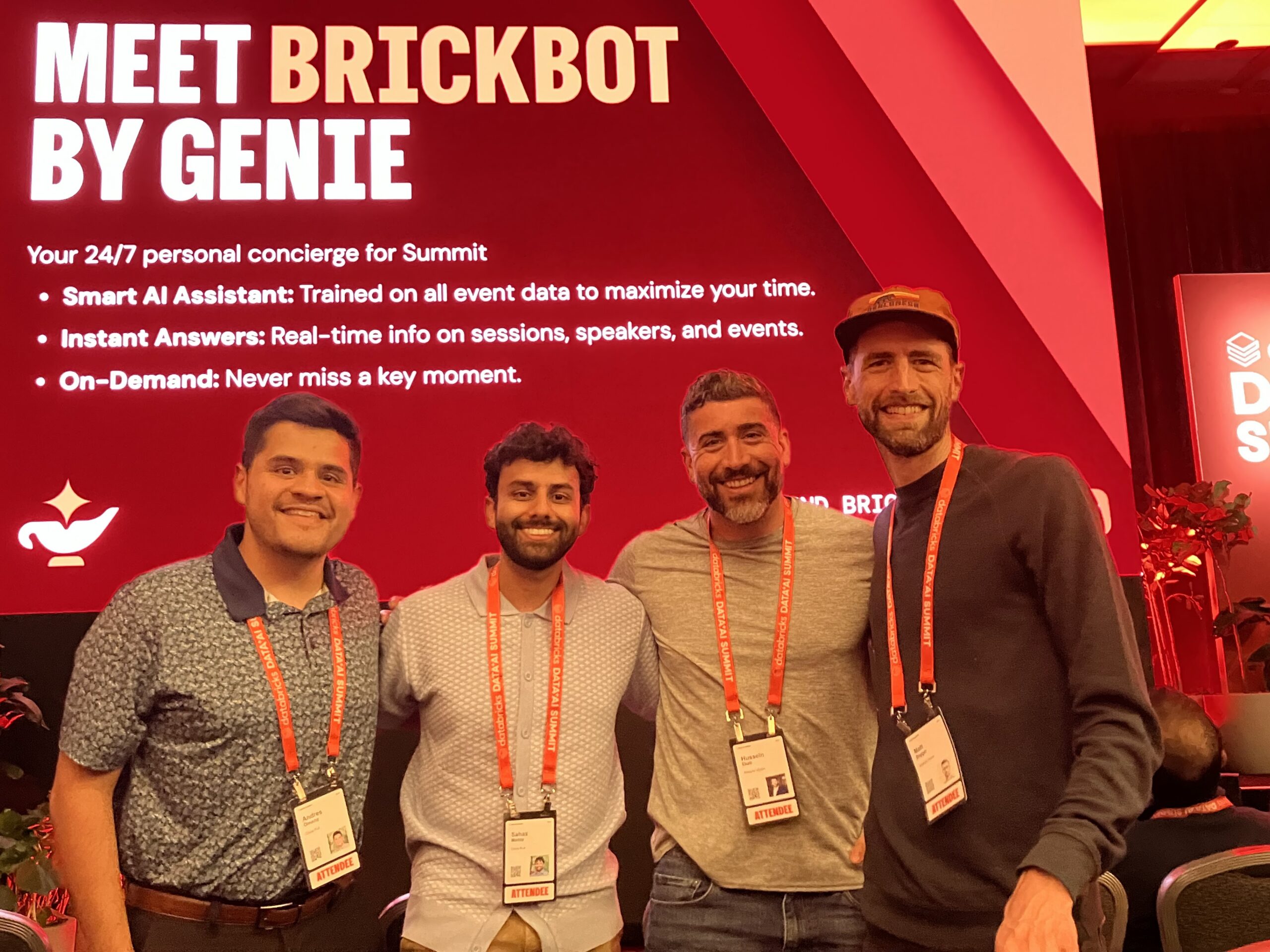
After a week at Databricks Data + AI Summit, Analytic Vizion’s Matt Bigger, and Hussein Diab saw one theme emerge.
The future of data is governed, intelligent applications that help people make decisions and take action.
For years, we’ve talked about the modern data stack naturally condensing into more unified platforms. At Summit, we saw that shift start to show up in real products and real builds. Here are five signal flares we think data, analytics, finance, and operations leaders should be paying attention to.


Flame 1: Apps on the lake, not just dashboards on a warehouse
What excited us most on the architecture side was Databricks Apps combined with LTAP (Lake Transactional/Analytical Processing).
Your custom enterprise apps can now be built and hosted directly in Databricks. With LTAP, you don’t have to push data out of a source system just to make it analyzable somewhere else. Data can be created through your app and immediately be queryable in the same governed environment.
We saw this play out in the Apps & Agents for Good Hackathon. Using Genie One, Claude Code, Lakebase, Unity Catalog, and a medallion architecture, we went from idea to working app in a short amount of time.
For leaders, this is the difference between “reports about the work” and “applications where the work actually happens.” It shortens the path from idea to impact, as long as architecture, governance, and user experience are designed together.
Flame 2: Governance is moving from access to understanding
We’ve always cared about governance. What’s changing now is what governance covers.
Unity Catalog remains the way Databricks manages data, permissions, and lineage. Genie Ontology adds a new layer that understands how your data maps to your business: metrics, entities, relationships, domains, and rules.
That matters because AI agents are only as useful as the data foundation behind them. If the data is not trusted, governed, modeled, and understood, the agent is just another interface on top of confusion.
What we saw at Summit was governance shifting from “who can see what” to “how do we help people and agents use the right data with the right definitions.” It’s closer to PageRank for your business data than a traditional access matrix.
The takeaway: this is how you keep AI from becoming a faster way to reach the wrong answer.
Flame 3: Agents are becoming shared, governed infrastructure
Another clear signal: agents are moving from side experiments to shared infrastructure.
Omnigent, the new meta‑harness, makes it easier to compose and collaborate with multiple agents on top of different models and coding tools. Unity AI Gateway adds a governance layer that enforces permissions, routing, guardrails, and budgets for those agents.
We like this direction because it recognizes two truths at once:
- You need a way to manage AI usage, tools, and spend as a platform capability.
- AI‑assisted development is real, but architecture still matters. It doesn’t replace the need to understand the problem, design the flow, validate the output, and tell the story clearly.
For leaders, this means AI is no longer just a new interface on top of data. It touches security, cost, compliance, and collaboration. Someone on your team has to own how agents are designed and governed, not just which model name sits in the config.
Flame 4: From “better dashboards” to governed, intelligent products
We saw a consistent expectation from business users at Summit:
They don’t just want reports. They want context, explanation, recommendations, and the ability to ask follow‑up questions in natural language.
Genie One and Genie Agents are clearly aimed at that consumption layer a “data‑smart coworker” that is grounded in your enterprise context. It points toward governed, intelligent applications that sit around your data.
At the same time, we’re not ready to retire BI tools. The native visualization layer in Databricks still feels weaker than mature tools like Tableau and Power BI for long‑term strategic reporting. We wouldn’t yet replace those for production reporting.
So we see the near future like this:
- Dashboards remain necessary for stable reporting.
- Governed, intelligent apps and agents grow around them to help people move from insight to action.
The key is knowing when a dashboard is enough, and when the business really needs an application or agent that’s closer to the decision moment.
Flame 5: Fundamentals matter even more in a platform world
There was a lot of talk at Summit about platforms, agents, and new capabilities. What stood out to us in the hackathon is how much the fundamentals still matter.
Bronze, Silver, and Gold are not old concepts. They become even more important when agents are reasoning over the data and users are relying on the output. Medallion architecture gave us clarity about where data belonged, how trustworthy it was, and how ready it was for an agent or app to use.
We’ve long believed the modern data stack of separate vendors would condense into a smaller number of platforms. After this Summit, it feels like we’re getting close.
But platform consolidation doesn’t remove the need for strong modeling, clear layers, and governance. It amplifies it. The teams that win this next phase won’t just have more agents; they’ll have trusted data foundations and product thinking on top.
What this means for your data organization
Here’s how we’d summarize it after a week in the rooms, on stage, and building alongside other teams:
- Data teams are moving from building reports to building intelligent data products.
- The “modern data stack” is starting to behave more like a governed platform.
- Success depends less on which tools you choose and more on how well you connect data, governance, and user experience to real decision moments.
For data, finance, and operations leaders, a few practical questions follow:
- Where are we still focused on “better dashboards” when our business would benefit more from governed, intelligent applications?
- Is our data foundation ready for apps and agents, or would they simply expose gaps in governance and modeling?
- How do we evolve our stack so existing BI continues to serve strategic reporting while new apps and agents support day‑to‑day decisions and actions?
These are the conversations we’re having back with our team and our clients after Summit. If you’re working through similar questions, on Databricks or elsewhere, we’d be glad to compare notes and help you think through your next steps.
Book a Meeting to start the conversation.